Relationships as Measurable Assets: What You Don’t Measure, You Can’t Compound
Avnir Blog – 27-Mar-26
There’s a quiet yet expensive illusion in most companies today: that relationships are inherently valuable but impossible to measure.
So, we dismiss them as soft skills, intuition, and “good chemistry.” We celebrate rainmakers, but we can’t explain why they succeed. We make huge investments in CRM and supporting GTM systems, but they only show what has already happened. In doing so, we overlook the most important lever of sustainable growth: the ability to measure, manage, and develop relationships as strategic assets.
The Hidden Gap Between Activity and Impact
Most organizations are not lacking activity; they lack visibility. You hold meetings, send emails, attend conferences, expand your network, log interactions, and build pipelines.
But here’s the tough question: which of those relationships actually move deals forward—not eventually, not anecdotally, but predictably, repeatedly, and at scale?
Your pipeline doesn’t stall because of a lack of effort; it stalls because of unseen relationship gaps. The missing executive sponsor who never got involved, the influencer who quietly derailed consensus, the inactive advocate who was never activated, and the internal misalignment that fractured external trust are not CRM issues; they are relationship intelligence issues.
From Contacts to Indicators
If relationships are assets, then like any asset, they need indicators. Not vanity metrics or activity logs, but leading drivers that signal strength, risk, and potential.
At Avnir, we think about three foundational relationship indicators: access, responsiveness, and advocacy behaviors.
Access is about whether you have meaningful entry to the right stakeholders—not just someone at the account or a title in your CRM, but trusted, contextual, decision-relevant access. Because access determines whether you’re even part of the conversation that matters.
Responsiveness measures how quickly and meaningfully your contacts engage; speed is not just operational—it’s relational. A two-hour response from a key stakeholder signals something very different than a two-week silence. Responsiveness acts as a proxy for priority, trust, and momentum, yet most organizations don’t track it carefully.
Advocacy Behaviors are the most underused yet powerful indicator—asking who speaks for you when you’re not present. Advocacy isn't about feelings; it’s about actions—introductions made, insights shared, and alignment built. Without advocacy, you lack a relationship advantage; you just have a fragile connection.
Why This Matters More Than Ever
We are entering a market where buyers are more consensus-driven, deals involve more stakeholders, trust is harder to earn and easier to lose, and larger firms are moving down-market with deeper relationship coverage.
In this environment, relationship blind spots turn into revenue leaks, and you won’t notice it in your CRM because by the time something appears there, it’s already a lagging indicator. The deal is already at risk, the influence map is already incomplete, and the opportunity is already compromised.
Relationships Show Up in the Forecast First
What if you could identify relationship strength before it appears in pipeline movement? What if your forecast wasn’t solely focused on stages and probabilities, but also on the depth of stakeholder coverage, the strength of internal advocacy, and responsiveness patterns across key accounts? Because here’s the shift: relationships don’t just support revenue—they actually precede it. They appear in the forecast before they even show up in the CRM.
The Compounding Effect Most Firms Ignore
When you consistently track the right relationship indicators, something powerful occurs: you begin to build compound value. Better access results in stronger conversations. Stronger conversations foster deeper trust. Deeper trust encourages more advocacy. Increased advocacy accelerates deal velocity. Faster velocity improves win rates. And the cycle continues. But without measurement, there is no compounding—only randomness.
The Myth of Relationship “Intuition”
Many leaders still believe relationships are best left to instinct. “That’s just how business works.” “You can’t quantify trust.” “Our people know how to build relationships.” Maybe. But if that were true, you wouldn’t see inconsistent win rates across teams, unexplained pipeline volatility, high activity levels with low conversion rates, or deals lost to competitors with inferior solutions. Intuition doesn’t scale. Measurement does.
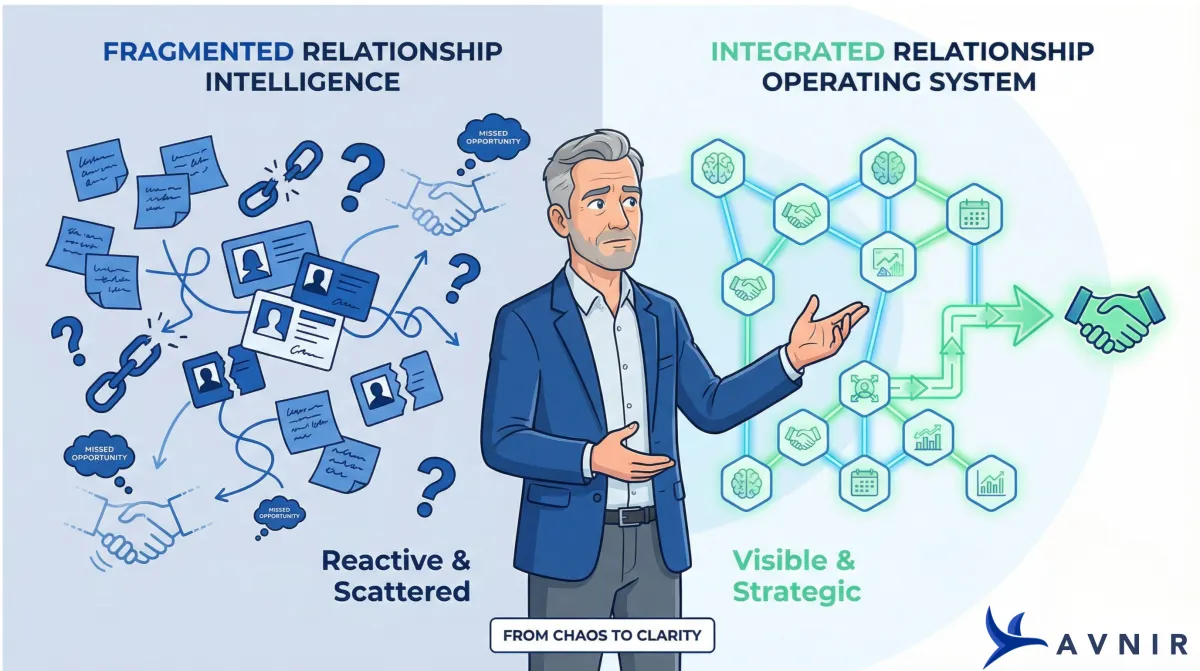
From Relationship Chaos to Relationship Intelligence
The future of growth isn’t about generating more leads; it’s about better leveraging the relationships you already have. Today, your firm holds untapped connections, overlooked advocates, hidden influence channels, redundant outreach efforts, and fragmented relationship ownership. What’s missing isn’t relationships—they’re there—it’s a system to see, understand, and activate them. That’s the shift from CRM to Intelligent Relationship Management (IRM).
Why Avnir Exists
Avnir was built on a simple but disruptive vision: if relationships are your most valuable asset, they should also be your most measurable. Not as static records or isolated contacts, but as dynamic, living networks of influence, access, and advocacy.
Through Avnir Insights and Avnir Connections, firms can map relationship ecosystems across accounts, identify gaps in stakeholder coverage, uncover hidden internal and external connections, measure responsiveness and engagement patterns, activate advocates at the right moments, and align teams around relationship strategy—not just deal execution. This isn’t just another layer on top of your CRM; it’s a fundamentally different perspective.
The Early Access Advantage
Most revenue leaders will read this and nod. Some will even agree. But very few will take action—and that’s where the advantage lies. Early adopters of relationship intelligence will identify risks others overlook, move faster with greater confidence, close deals before competitors even grasp the dynamics, and build institutional knowledge—not just rely on individual heroics. They won’t just manage pipelines; they’ll orchestrate relationships.
A Provocation for Leadership
If you’re a CEO, CRO, or Managing Partner, consider this:
Can you measure the strength of your top 20 client relationships?
Do you know where your current biggest relationship gaps are?
Can you foresee which deals might be at risk because of weak stakeholder coverage?
Are your teams working together on relationship strategy, or just focusing on activities?
If the answer is no, you’re not alone—but you're also vulnerable.
What You Don’t Measure, You Can’t Compound
We’ve spent decades optimizing processes, technologies, and data, yet we’ve largely left the most critical driver of growth—relationships—unstructured and unmeasured. That era is coming to an end. The companies that succeed next will not be those with the biggest pipelines; they will be the ones with the strongest, most measurable, and most strategically managed relationships.
Your Next Step
If this resonates—even uncomfortably—you owe it to your firm to explore what’s possible. Avnir’s Early Access/Beta program isn’t just about software; it’s about providing visibility into what’s already happening inside your relationships and empowering you to act on it. Because once you can see it, you can measure it—and once you measure it, you can grow it. The question isn’t whether relationships matter; it’s whether you’re willing to treat them like the assets they truly are.
Apply for the Avnir Early Access Program HERE…
